Family Tree
A bilingual family tree a Bangladeshi family can actually keep: build it in the browser before signing up, invite relatives with a link, and read it on the phone offline.
What it is
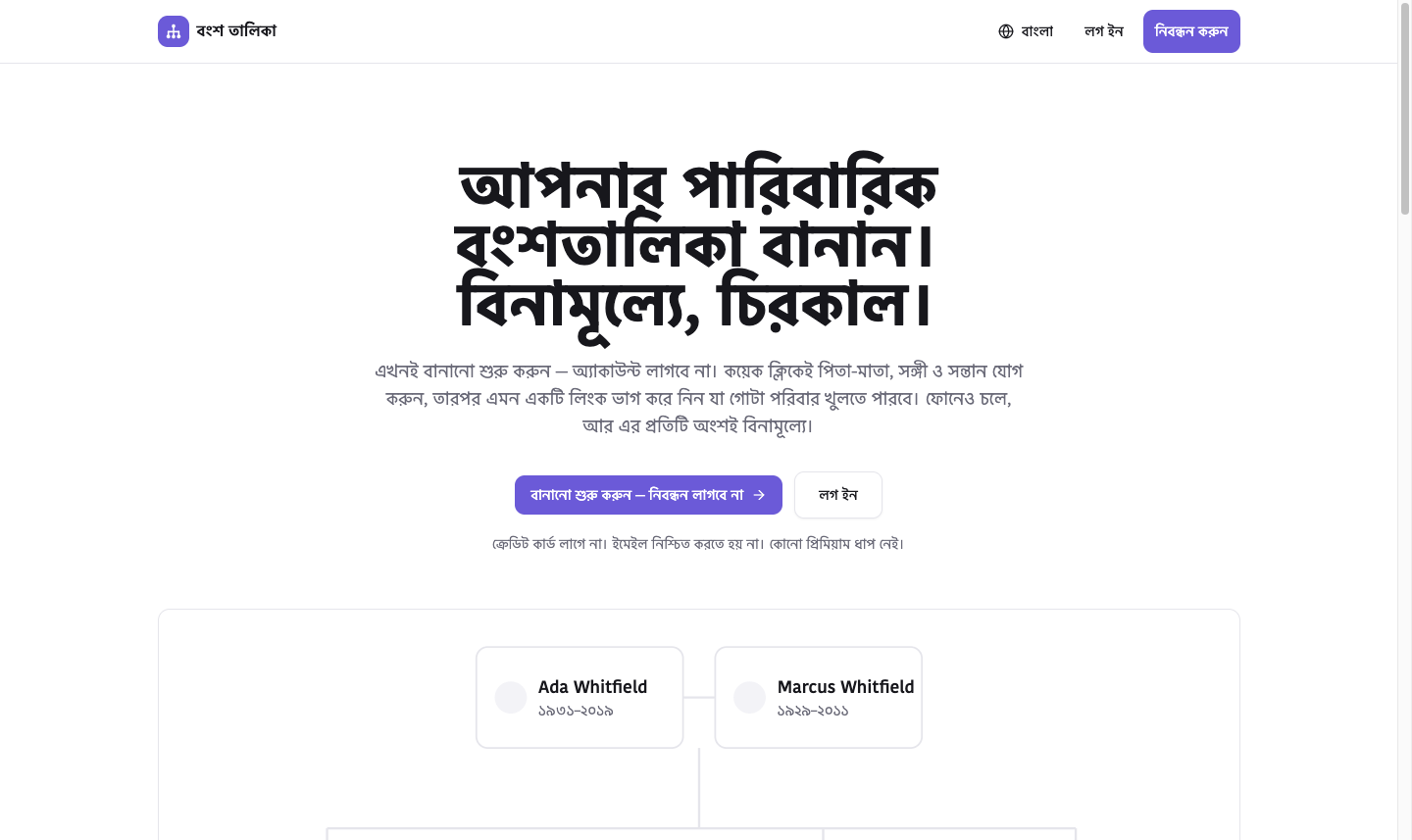
Most family-tree sites ask for an account and a card before they show you anything. This one opens on a blank canvas: add your parents, your partner, your children, and the tree is already yours in the browser. Registering moves that draft into an account — nothing to re-enter.
It is built for Bengali-speaking families, so every string exists twice, Bengali and English, in one catalogue shared by the website and the phone app. The whole thing is free, with no paid tier to move up to.
The web app is Nuxt 4 on Cloudflare Pages with D1 as the only datastore. The Flutter app is a pure client of that same API: no second backend, no separate database, and the tree layout comes from the server, so the phone and the laptop draw the same shape.
What it does
- Start before signing up. The draft canvas runs entirely in the browser and keeps the tree in local storage. When you register, the draft is claimed into the new account in one step, and claiming twice cannot duplicate it.
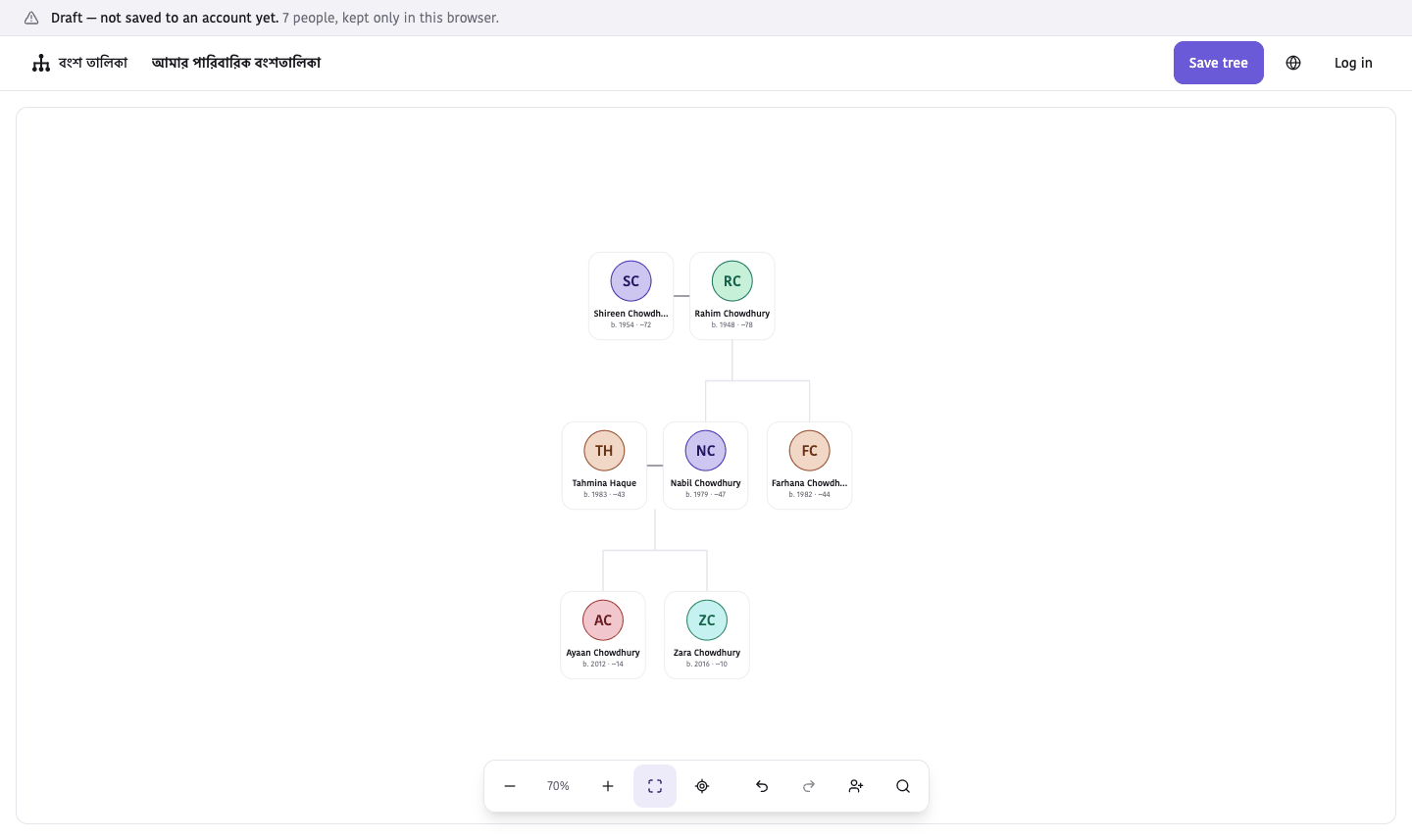
- A canvas built for relatives, not boxes. Add a parent, partner, child or sibling straight from a selected card. Generations lay themselves out, any card can be nudged and the override is kept, and there is undo, redo, pan, pinch-zoom, locate-a-person and autosave with a visible save state.
- Five ways to read the same tree. The canvas, plus table, pedigree, descendants and timeline views, each with its own tested model, and a faceted search across everyone in the tree.
- Partial dates and step relations survive. Dates are stored as written and as parts, so "abt 1920" and "March 1954" are not rounded into a lie. Parent links carry a kind, and partnerships are their own entity with their own dates, so remarriages, step-parents and adoptions stay representable.
- Memories and photos. Stories with a title, a partial date, several photos and the people they are about, attached to the tree rather than to one person — and kept outside the version history, so restoring the graph can never delete yesterday’s photos.
- Share and invite. A view-only public link, optionally behind a password and an expiry date, with the unlock attempts rate-limited. Relatives join as viewer, editor or admin through an invite link you send yourself, which can be locked to one person’s email address.
- Every edit is recoverable. Changes are recorded as revisions grouped per editing sitting, with a before-and-after preview and restore, kept for 200 entries or 90 days. The tree also exports as GEDCOM 5.5.1.
- The phone app reads offline. Flutter on iOS and Android, signed in with a bearer token against the same API, caching each tree to disk so it opens instantly and stays readable with no signal. Editing still needs the network.
How it was built
Built with Claude Code as the pair, on the same rule as everything else here: the parts worth trusting are the parts under test. About fifty server tests run against a booted Nitro server with a real D1 database — roles, invites, cross-tenant isolation, history recording and restore, the share viewer, GEDCOM — and about forty-five unit tests cover the pure modules the two clients share, including the layout engine.
Running on Cloudflare’s free tier shaped the design rather than the other way round: the share-link unlock budget lives in D1 because adding KV would have meant another storage dependency, and the push notification JWT is signed by hand with WebCrypto because there is no Node crypto at the edge. The code says so in comments — most non-obvious decisions name the alternative that was rejected.
What it deliberately does not have: no email of any kind, no social login, no GEDCOM import, no live collaboration. Those are honest gaps, not a roadmap I am pretending to have finished.
Screenshots
Questions
Happy to go into how any of this was built:emtiazzahid@gmail.com, orthe contact page.